
In late September, I started using Grok Bot: eight specialized agents, and a real-life test of one idea, that applications are going headless.
Grok Bot is a multi-agent assistant from xAI: instead of one generic chat, you run several agents side by side, each with its own scope, memory, connectors, and scheduled routines. I drive mine from the chat, the desktop app, or my phone.
I opened it the way you open a fresh notebook, with no grand plan, to see whether a multi-agent assistant could keep up with my actual life: work, side projects, paperwork, personal site, blog, product ideas.
This is not a tutorial. It is my journal: what I wired up, what worked, what is still in progress.
The idea underneath: applications are going headless
I think the future of applications is headless: no classic interface sold as the product, fewer dashboards, more agents that deliver an outcome: closing an incident, filing a document, shipping a post.
Everything below is me testing that conviction on my own life, with the least glamorous material available: paperwork, a personal site, five hosted apps, a blog.
The most explicit attempt is called Pager, further down. If you only read one section, read that one.
Why agents rather than a chat
My days are spread across Craft (my notes and documents tool), Google Drive, GitHub, Clever Cloud (the platform that hosts my apps), X, and LinkedIn.
With a generic chat, every topic meant re-explaining everything: the blog context, the state of an app, the latest post.
What sold me was the chance to split my operational brain into stable roles, each keeping its own mission memory. Eight heads, one box.
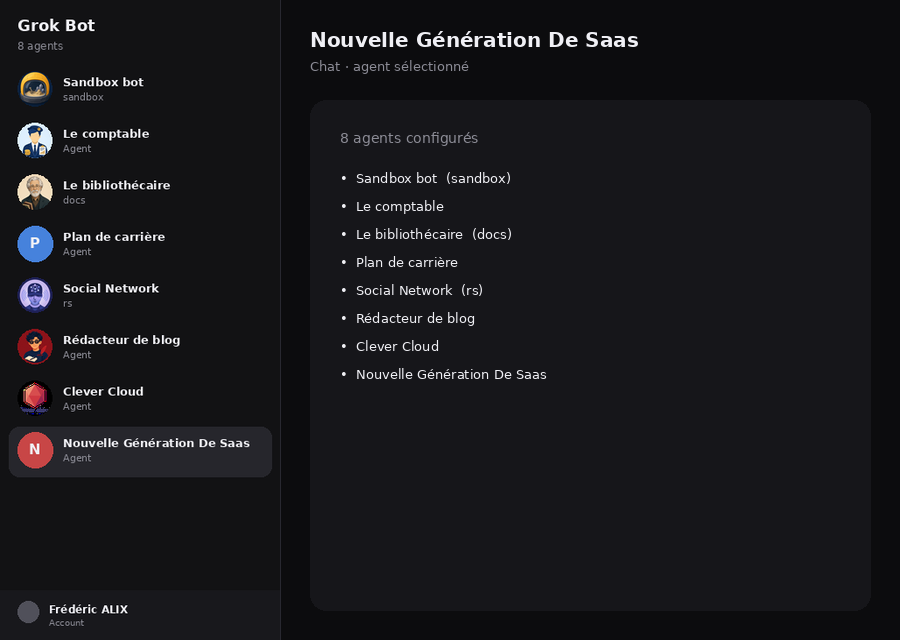
My eight agents in the Grok Bot desktop app (agent names are in French).
Three of those agents deserve a closer look. The other five fit in a few lines.
The Clever Cloud agent: real ops, not slides
The Clever Cloud agent drives my apps from the command line with clever-tools, relies on a local docs knowledge base, and refreshes it every month through a routine.
It looks after five apps: this blog, my personal site, another site, and Pager’s backend and database.
We set up automatic deploys: a GitHub Action that calls a Cursor webhook (Cursor being the code editor with built-in agents). We spun up a throwaway trial, then deleted it. We stopped Pager’s backend on purpose, with a restart planned.
The part that actually changes my day: all of it happened by voice, from the Grok Bot iOS app.
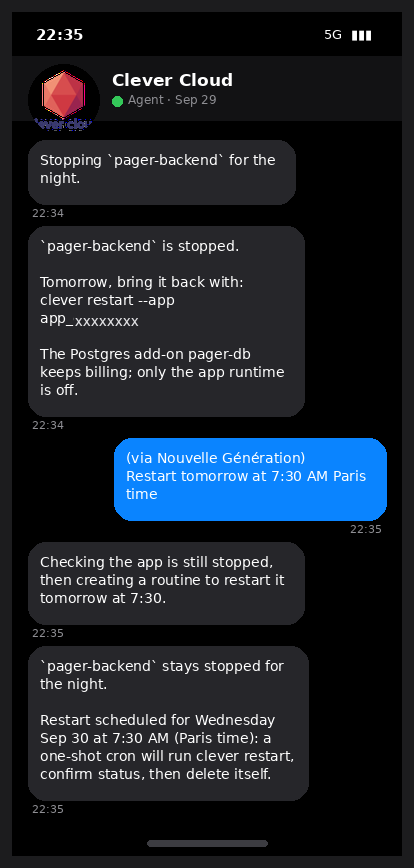
Stopping Pager’s backend for the night and scheduling its restart, from my phone. The app ID is masked.
I no longer open the Clever Cloud web console for these apps. The agent can stop, schedule, and document, which is exactly what I want from an ops tool.
The Blog writer: this post
The Blog writer looks after blog.fredalix.com, an Astro site in a private repo.
The process is deliberately slow and readable: topic → French draft → validation → French and English versions → push → build check.
The blog’s editorial rules live in an AGENTS.md, written from the repo’s CLAUDE.md: state the thesis before the inventory, define every tool, never publish a personal amount, push nothing without my green light.
You are reading the first post that went through this pipeline. If the tone feels too “journal” or too technical, tell me: that is also why a human stays in the loop.
Pager: a headless idea, not a product
The product agent, Nouvelle génération de SaaS (“next-generation SaaS”), carries an idea I treat strictly as a proof of concept, not a launched product: Pager that repairs.
The thesis: the language model does the thinking, and we build the execution plan: rules, runbooks (written procedures), guardrails, audit trails.
Planned stack: Rust and PostgreSQL 18, hosted only on Clever Cloud, with the API described in OpenAPI.
So far there is a one-pager, diagrams, an MVP prompt, an MVP test suite at 91 PASS, and a write-up of the T-41 case: retries when a service stops responding properly.
Pager is the headless thesis applied to on-call: the main interface is the chat, the webhook, and the audit log, and a human steps in only when confidence is low.
Two videos shaped my thinking on this shift from interface to outcome:
- Rails World 2026 Opening Keynote, DHH
- GPT-6 Astra vient-il de tuer les SaaS ?, Yannis Haismann (in French)
The Rust code in the pager repo comes from my own keyboard: the agent speeds up framing, tests, and docs. No magic.
The other five, briefly
- Sandbox: my lab for testing routines and webhooks (automatic notifications fired when an event happens) before wiring them anywhere else. Lesson learned: do not install Tailscale, my private network between machines, on the agent’s machine; go through my computer when needed.
- Accountant: pay slips, budget, household tax paperwork, and a first 2026 income-tax estimate. No figures here: the process matters, not the amounts.
- Career plan: a status check on my online presence, and the rebuild of fredalix.com: a merged pull request with FR/EN versions, structured data for search engines, an apex domain, and a Let’s Encrypt certificate. Plus an SEO guide and a GitHub profile README.
- Social Network: my writer for X and LinkedIn. It drafts, I approve, we publish. First results: an English post about Grok Bot and webhooks, and an illustrated LinkedIn post sent through Composio (the connector that publishes on the agent’s behalf).
- Librarian: keeps the docs in Craft and acts as a search engine for the other agents. Its most useful contribution: a weekly recap every Tuesday, strictly limited to the last seven days. Without it, brilliant conversations pile up and you forget what actually moved.
Put together, my day looks less like “open fifteen tabs” and more like “hand off a named workstream”. This is not science fiction. It is orchestration.
What stays intentionally incomplete
- The private Tailscale network is not connected on the agent side. That is on purpose.
- September expenses are not all logged, and the monthly finance routine is not set up yet.
- My LinkedIn headline is out of date.
- Pager’s backend is stopped, waiting for a restart.
- The bot cannot post to X directly yet: today the agent prepares a draft and I publish it.
That is not failure; it is what a living product looks like. An agent claiming to finish everything in 48 hours would worry me more than excite me. What I want is a system that moves forward every week, hence the Tuesday recap.
Where I see Grok Bot going
Soon, Grok Bot will be my companion for running my personal services and infrastructure: sites, apps, paperwork, social presence, docs, and headless experiments like Pager. Less friction between intent and execution, more traces I can reread.
The same discipline (specialized agents, webhooks, runbooks, human approval on sensitive actions) carries over naturally to on-call and incident follow-up at work. I am promising nothing on that front in this post.
But when you practice letting an agent close an incident at home, you ask sharper questions in prod.
How do you slice yours?
If you already run agents, I would like to know two things: how many you have, and which one disappointed you most.
Reply to me on X @fax_v2_0. I share what I learn as I go, including the PoCs that stay ideas.